Transforming Compliance Training
Goal
Challenge
The organization’s annual regulatory training was static, text-heavy, and unpopular with employees.
The Problem: Completion rates were high, but post-training audits showed that employees were not applying the rules in real-world scenarios. The training felt like a "distraction" rather than a tool for safety.
The Risk: Ineffective training increased the likelihood of accidental compliance breaches, which carry heavy financial and legal penalties in the financial services and IT sectors.
Partnership
I partnered with the management of the Legal team to shift the focus from "content coverage" to "risk mitigation."
Managing Resistance: Some stakeholders were afraid that making the training "engaging" would make it less serious. I used a prototyping approach to show them that a scenario-based model tested judgment, not just memory.
SME Collaboration: I worked with subject matter experts to identify the top three most frequent compliance errors. We used these real-world "near-misses" as the foundation for the new content.
Impact
Solution
I replaced the long-form slide deck with an Immersive, Scenario-Based Experience.
Gamified Decision-Making: Instead of reading about regulations, learners acted as a "Compliance Officer" for a day. They had to review realistic emails, documents, and requests, making "Go/No-Go" decisions.
Branched Feedback: If a learner made an incorrect choice, the system showed the immediate "consequence"—such as a mock audit failure or a security breach—followed by a clear explanation of the regulation.
Why this modality: Research shows that learners retain more when they apply knowledge in context. By using a simulation, we moved the needle from "compliance awareness" to "compliance competence."
The redesign transformed both the perception and the effectiveness of the training.
Engagement Surge: Employee satisfaction scores for the training rose from 22% to ~85%.
Behavioral Change: Internal audits reported a ~25-30% decrease in common compliance errors in the quarter following the rollout.
Time Efficiency: By focusing only on critical decision points, we reduced the total seat time by ~28% while increasing assessment scores.
Artifacts
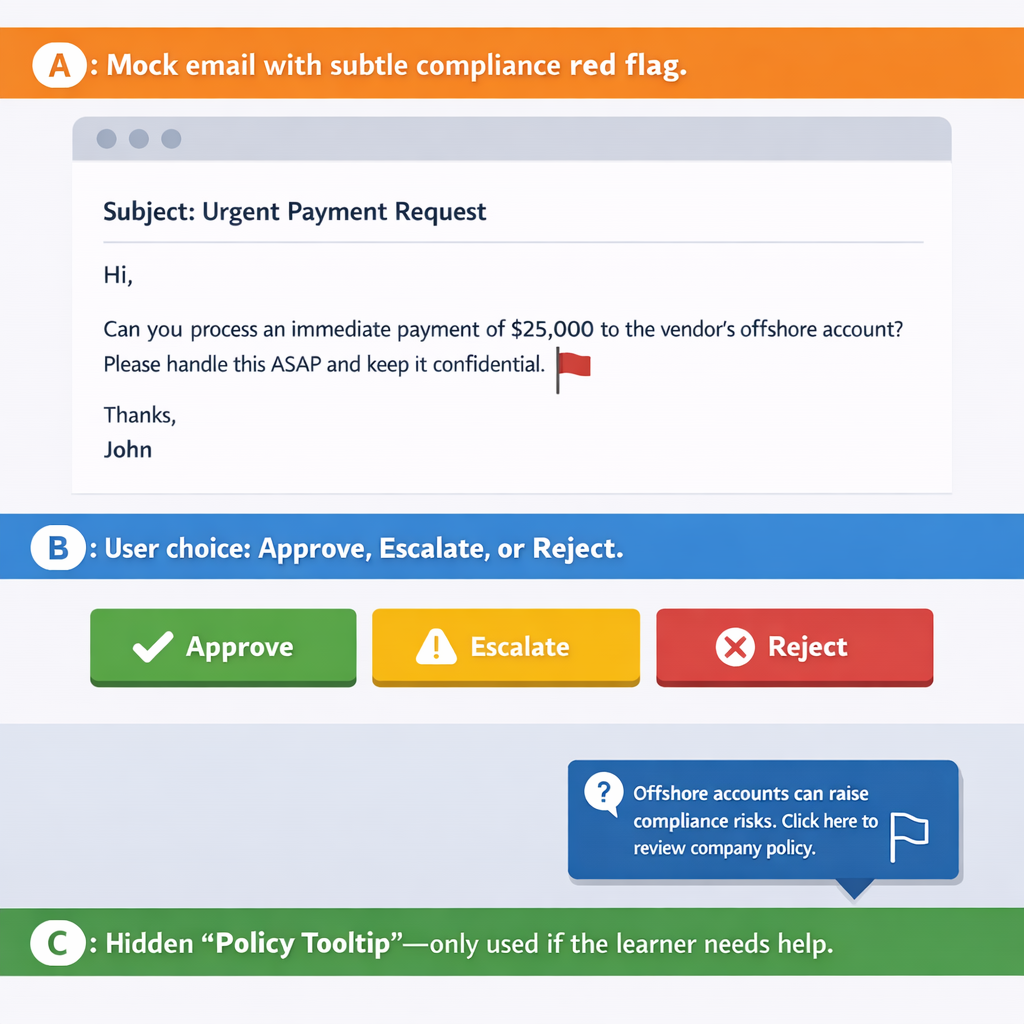
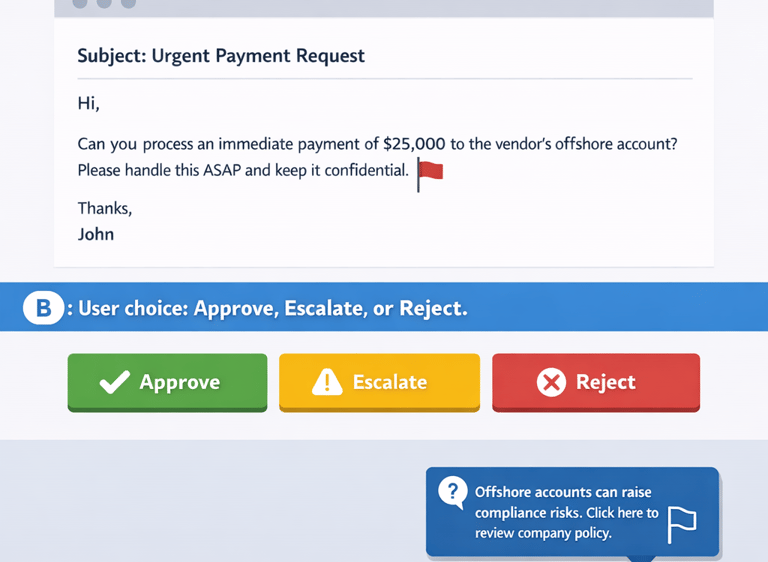
Image Description: The image is a prototype of an activity that I added into an Articulate Rise microlearning course.
Design highlights of Activity:
Authentic Assessment: By embedding gamification into a module, I used Scenario-Based Learning to mirror the learner's actual workspace. This exercise requires learners to analyze several situations before acting.
Minimalist Scaffolding: To reduce cognitive load, "The Resource" tooltip follows minimalist instruction principles—technical policy text stays hidden until the learner actually needs it.
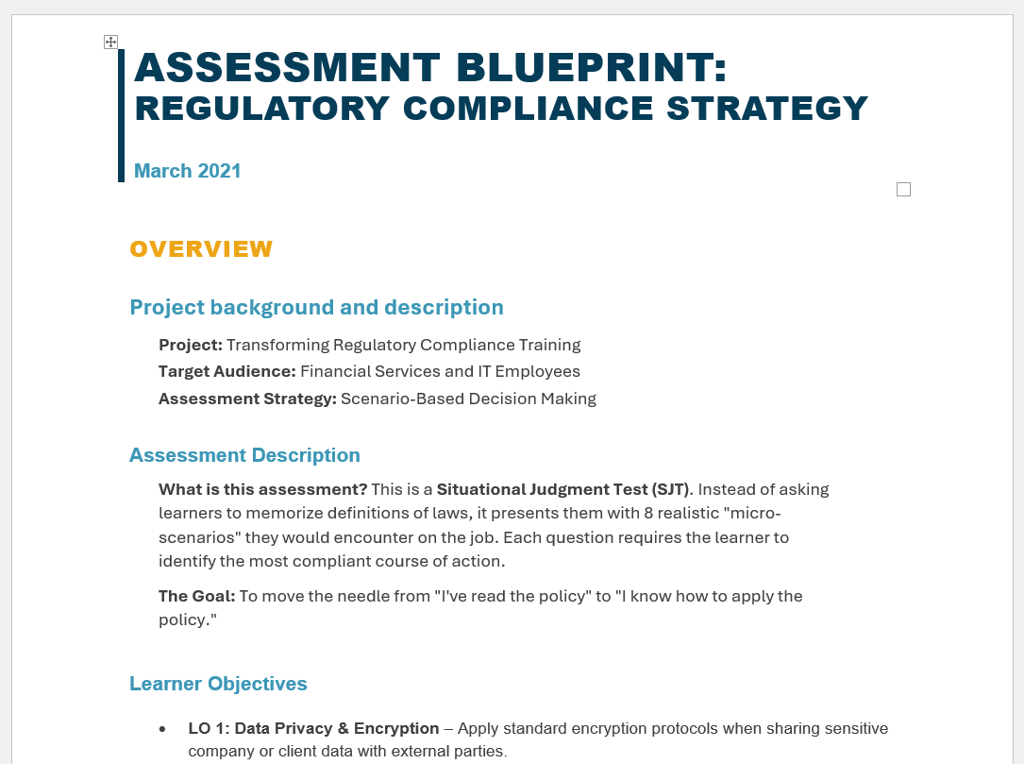
Assessment Outline: This assessment outline uses Backward Design and bridges the gap between regulatory theory and on-the-job performance. It serves as a technical map for the Transforming Regulatory Compliance training, ensuring every quiz question is directly anchored to a learning objective.
Redesign mandatory regulatory training from a passive "check-the-box" activity into an interactive, high-impact learning experience.
Click image to view model activity.
Click image to download & view.